
Why Successful Men Feel Disconnected Even When Life Looks Fine
Why successful men feel disconnected usually has nothing to do with laziness, weakness, or a lack of discipline. In fact, it’s often the opposite. They’re the men who handle pressure, hit deadlines, solve problems, and keep moving. From the outside, life looks solid. Work gets done. Responsibilities get carried. People rely on them. But under the surface, something starts to go flat. Conversations feel thinner. Patience gets shorter. Home starts to feel like another place to perform instead of a place to be present.
That disconnection doesn’t happen all at once. It builds quietly when achievement becomes a way to stay in control. Output replaces honesty. Composure replaces presence. You stay productive, but less available. Sharp at work. Distant at home. Useful everywhere. Fully present nowhere.
If that sounds familiar, the issue is not that you need less ambition. It’s that success may be covering over something deeper. The real work is learning how to stay driven without using performance to hide from what’s true.
Because your identity-level rule is simple: I am the man who can carry it. The violation isn’t about failing; it’s about not needing anything—rest, reassurance, time, help, or a minute to feel what’s true.
So you keep performing even when you’re emotionally thin. Because slowing down doesn’t feel like recovery. It feels like sliding backward.
And the rationalizations come out clean.
“I’ll deal with it after this deadline.”
“No one needs to hear this from me.”
“It’s not that serious. I’m just tired.”
Here’s the micro-scene. You know it.
You’re in the kitchen. Laptop open. The screen throws that cold light onto your hands. Phone buzzing against the counter like a small alarm you refuse to shut off. You’re half-standing, half-leaning, shoulders forward. Your foot taps without permission.
Your partner walks in and stops. Not angry. Just watching you.
“Are you even here right now?”
You half-smile. You keep typing.
“Yeah—just give me 10 minutes.”
You already know it won’t be 10. You feel the sting in your chest and the heat behind your eyes for half a second. Then you clamp it down. You type faster. You widen the gap on purpose. Output becomes your shield.
That’s the negotiation. Not with them. With yourself.
You don’t want to be the guy who needs space to process. You want to be the guy who can handle it.
Why Achievement Can Make Successful Men Feel More Disconnected
Emotional control through achievement is common in high-standard men who don’t miss deadlines and don’t show need. It looks like discipline. It often reads as composure.
Under the hood, it’s a strategy: use output to avoid exposure—uncertainty, frustration, grief, disappointment—anything that would force a clean, honest sentence.
What’s actually happening isn’t complicated. It’s just expensive.
You use achievement to control emotion. Output becomes the lever you pull to avoid the discomfort of naming what’s true.
The internal rule running the show is: high standards mean no visible need. If you admit uncertainty, disappointment, grief, fear—anything that looks like a crack—you believe you’ve loosened the bar.
So you keep the bar high, and you keep your face flat.
It feels justified because it works in the short term.
You get results.
You stay respected.
You don’t risk being seen as messy.
You call it composure.
Most of the time, it’s high-functioning emotional avoidance with good posture.
Here’s the emotional sequence, step by step.
First comes relief. You dodge the moment. You don’t have to feel the thing. You don’t have to name it. You don’t have to deal with the look in your partner’s eyes or the question from your team you can’t answer cleanly. You get a hit of control.
Then comes subtle tension. It shows up in your body before your mind admits anything. Jaw tight. Shallow breathing. A constant pressure behind the ribs. You start cutting people off mid-sentence because their pace feels threatening.
Then anxiety. Not panic. Drift. Something’s off, but you refuse to stop long enough to see it. You start checking messages more. You re-read threads. You chase certainty through activity. You tell yourself you’re just staying on top of things.
Then the lowered standard. This is the part you don’t want to see.
You take shortcuts because you’re trying to kill discomfort rather than solve the problem. Your tone gets harsher. Your honesty gets smaller. You stop saying what you actually see. You start managing impressions.
You call it discipline.
It’s emotional silence with a checklist.
You call it staying focused.
It’s staying numb.
You call it protecting the mission.
It’s protecting your image.
How Disconnection Shows Up at Work and at Home
This doesn’t stay inside you. It shows up in rooms.
At Work: Disconnection Looks Like Pressure, Control, and Polished Updates
Under pressure, you stop asking questions.
In meetings, you shift from real status to polished updates. You speak in clean sentences. You avoid details that would reveal uncertainty. You avoid the one hard conversation that would slow the project but save the team.
“We’re fine—just execute.”
What you don’t say is: we’re behind, and I’m not sure.
You choose speed over truth. That choice has a cost.
Small issues go underground because you’ve made it unsafe to surface them. Not by yelling. By signalling that problems are interruptions. People start editing what they bring to you. You get a quieter room, and you mistake it for alignment.
Rework shows up later as a fire.
And the leadership spillover is visible if you’re paying attention. Your directive tone starts to wobble.
When you’re grounded, your direction is clean. People can feel the standard and the calm behind it.
When you’re protecting your image, your direction gets slippery.
It becomes: “If you can, maybe tighten that up by EOD.”
That’s not kindness. That’s uncertainty disguised as politeness. The room hears it.
People start freelancing.
They check with someone else before acting because your guidance feels less stable. A senior team member starts “confirming” decisions with another lead. Not because they’re undermining you. Because they’re trying to reduce risk.
Your body gives you away.
Shoulders forward.
Eyes down.
Voice clipped.
And others adjust.
You stop walking the floor. You stay at your desk. You answer quickly but without contact. You’re present, but you’re not available.
The room gets quieter when you enter. Not out of respect. Out of calculation.
At Home: Disconnection Looks Like Distance, Efficiency, and Emotional Minimalism
At home, it shows up as efficiency without warmth.
You “help,” but it feels like a transaction. You answer with logistics. You keep moving while someone is talking to you. You scroll while listening, telling yourself you’re still hearing them.
Your partner says, “I miss you.”
You say, “I’m right here. What do you need?”
That line sounds practical. It lands cold.
You trade connection for being useful.
You think you’re providing.
What you’re actually doing is minimizing emotion because it feels like a loss of control.
The same strategy you use at work shows up as emotional minimalism at home. You stay intense where performance is rewarded, and you go absent where presence is required.
Again, your body gives you away.
Sitting angled away.
Foot bouncing.
Jaw set.
Voice flat.
And your family adjusts.
Your partner stops raising real concerns and starts handling things on their own. Not because they stopped caring. Because they’re tired of being met with a wall.
Kids get louder to get a response.
Or they get quieter to avoid you.
The Hidden Cost of Disconnection for Successful Men
The hidden cost isn’t that you stop achieving.
It’s that you start leading through pressure rather than through presence.
You lose the ability to set the tone without force. You start pushing harder because your calm isn’t available. You rely on urgency, sharpness, and speed to keep everything moving.
And it breaks in a predictable order.
Clarity drops first.
You stop naming the real problem. You talk around it. You update people on tasks rather than telling the truth about the risks. You avoid sentences that would expose you: “I don’t know yet.” “This isn’t working.” “We need to reset.”
Decisiveness turns reactive.
You make fast calls to kill discomfort, not because the decision is right. You choose the option that ends the conversation. You shut down the debate early. You confuse speed with strength.
Presence becomes performance.
You’re “there,” but not available. Your face is controlled. Your words are correct. Your energy says, “Don’t bring me anything complicated.”
If this goes unexamined, the trajectory is simple.
He stops setting the tone.
He starts managing optics.
He becomes harder to approach, then quietly easier to ignore.
What erodes first is standards.
Not the standards you talk about. The standards you live.
Because you start redefining “winning” as avoiding emotional exposure. You start choosing the version of success that keeps you untouchable.
Then authority follows.
Not because people stop respecting your competence. Because they feel the gap between what you say and what you’re willing to face.
They can work with a demanding man.
They can’t trust a man who won’t tell the truth about what’s happening inside the room.
Why Most Advice Doesn’t Help Disconnected Successful Men
Most advice fails here because it treats this like a mood problem.
“Get motivated.”
“Take a weekend.”
“Be kinder to yourself.”
Motivation doesn’t fix an identity rule.
If your internal contract says, High standards mean no visible need, then motivation just helps you double down. You don’t slow down. You get sharper. You get more efficient. You get more convincing.
Even good advice gets misused.
“Be kinder to yourself” turns into another avoidance strategy. Not rest—escape. Not recovery—permission to stay unnamed. You call it self-compassion, but you’re still refusing the clean sentence that would correct the drift.
The issue isn’t that you feel pressure.
The issue is how you avoid being seen under it.
A lot of “vulnerability” advice misses the mark for the same reason. If you treat honesty as emotional release, you’ll confess just enough to feel lighter—and change nothing structural. Your team hears it as uncertainty. Your partner hears it as another temporary opening that closes the moment the heat returns.
Relief is not repair.
Comfort is not alignment.
Two lines to keep you honest:
- You call it self-care. It’s procrastinating the truth with a softer voice.
- You call it vulnerability. It’s disclosure without correction.
Identity alignment matters more than emotional comfort.
Not “feel better.” Be congruent.
Driven men’s emotional numbness isn’t a personality trait. It’s a strategy that gets rewarded—until it starts costing you self-trust and leadership presence.
How Successful Men Can Stay Driven Without Feeling Disconnected
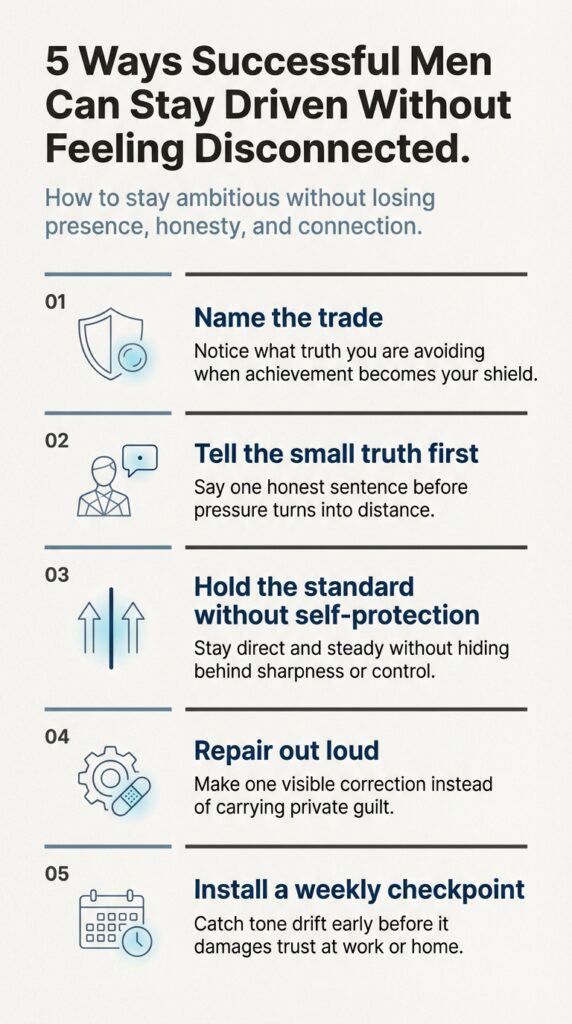
These are not “mindset” steps. They’re behaviour corrections.
1. Name the trade you’re making
Identity anchor: I don’t buy control with silence.
Resistance pattern: “This is just how winners operate.”
Practical implementation: Before a hard push, write one sentence:
“If I win this week, what truth will I avoid saying?”
Then answer it in plain language. No story. No justification.
Behavioural shift: You stop treating output as proof you’re fine. You start treating output as a tool you can use cleanly.
Leadership spillover: Your updates get real again. You name risk early. You stop rewarding optimism and start rewarding accuracy.
2. Tell the small truth first
Identity anchor: I can be direct without being dramatic.
Resistance pattern: “It’ll sound weak.”
Practical implementation: Choose the lowest-risk honest sentence that is still real.
– To your team: “We’re behind on scope. I need cleaner estimates today.”
– To your partner: “I’m here, but I’m not fully present. I need 20 minutes, then I’m putting the phone away.”
No speech. No backstory.
Behavioural shift: You stop waiting until you’re forced into a blowup or a shutdown. You give reality in small doses.
Leadership spillover: People stop guessing what’s true. The room gets louder in a good way. Issues surface while they’re still cheap.
3. Hold the standard without shutdown
Identity anchor: My authority doesn’t require me to look unbothered.
Resistance pattern: “If I admit pressure, I lose authority.”
Practical implementation: State the standard and name the emotion without dumping it.
“This needs to be fixed by Friday. I’m frustrated because it matters—let’s solve it.”
Notice what’s missing: blame, sarcasm, the courtroom tone.
Behavioural shift: You stop using sharpness to feel in control. You keep expectations high and let your face match reality.
Leadership spillover: Your direction stabilizes. “If you can” disappears. People feel your standard without having to manage your mood. You hold the standard under pressure.
4. Repair trust in leadership out loud, not in your head
Identity anchor: I don’t pay for mistakes with private guilt.
Resistance pattern: “I already feel bad—why revisit it?”
Practical implementation: Make one visible correction within 24 hours.
“Yesterday I got sharp. Here’s the decision. Here’s what I need from you today.”
Or at home: “I was checked out last night. I’m making dinner, and I’m off my phone.”
Keep it short. Keep it concrete.
Behavioural shift: You stop treating repair as an internal emotion. You treat it as an external action.
Leadership spillover: Trust rebounds faster. People don’t have to wonder if your edge was “the real you.” They see consistency.
5. Weekly checkpoint to prevent tone drift
Identity anchor: I don’t let tone rot quietly.
Resistance pattern: “I don’t have time for this.”
Practical implementation: Ten minutes. Same day each week.
Two questions:
1) “Where did my tone shift from directive to defensive?”
2) “What’s one message I owe that restores clarity?”
Send one repair message. Make one calendar adjustment. That’s it.
Behavioural shift: You stop relying on willpower to stay aligned. You build a simple mechanism that catches the slide.
Leadership spillover: Your team gets fewer surprises. Your home gets fewer “versions” of you.
Wondering how to begin Self-Led Accountability
Successful Men Don’t Need Less Drive. They Need More Presence
You can keep the drive.
You can keep the edge.
Drop the need to be untouchable.
Say the small true thing.
Hold the line.
Repair fast.
Stay clean.
And if you recognize the pattern for what it is—emotional control through achievement—you can keep producing without going numb.